Beyond the Factory Floor: Why Your Smart Manufacturing Strategy Needs IoT and CRM Integration
The Intelligence Gap in Industry 4.0
For the past decade, the "Smart Factory" has been the holy grail of manufacturing. We have invested billions into automation, edge computing, and real-time monitoring. Our machines are talkative streaming runtime data, fault codes, and OEE metrics 24/7.
But here is the hard truth: If your factory floor doesn’t talk to your customer service team, your factory isn’t truly "smart."
A critical gap still exists in most industrial organizations. Operational data (OT) rarely connects directly to Customer Relationship Management (CRM) systems. This disconnect creates a "visibility wall" where the people responsible for the machines know exactly what’s happening, but the people responsible for the customers are left in the dark.
At Ankercloud, we believe the future of manufacturing isn't just defined by automation, it’s defined by connectivity and customer-centricity.
The High Cost of Siloed Systems
When factory operations and customer engagement live in separate silos, the business pays the price in friction:
- Service teams are reactive: They wait for a customer to call and complain about a breakdown that the machine reported hours ago.
- SLA risks are invisible: Production slowdowns go unnoticed by sales teams until a delivery is already late.
- Trust is eroded: Customers receive delayed information, leading to frustration and missed opportunities for proactive support.
A smart factory without a connected CRM is like a high-performance engine without a dashboard, it’s running fast, but you have no idea if you’re heading toward a breakdown or a finish line.
Closing the Loop: The IoT + CRM Architecture
Integrating an Industry 4.0 IoT platform with your CRM (like Salesforce, Dynamics 365, or HubSpot) creates a live reflection of your operations. Here is how we build that bridge:
- The Factory Layer: Sensors and PLCs collect machine telemetry (vibration, heat, cycles) in real-time via OPC-UA or MQTT gateways.
- The IoT Platform Layer: A platform like AWS IoT Core ingests this data, computes KPIs like OEE, and triggers alarms based on anomalies.
- The CRM Integration Layer: This is where the magic happens. Through secure APIs, factory events trigger automated workflows in your CRM.
Four Use Cases That Redefine the Customer Experience
How does this integration look in practice?
1. The "Self-Healing" Service Case
A machine on the floor throws a fault code. Instead of waiting for a manual check, the IoT platform automatically creates a service case in the CRM, assigns a technician, and orders the necessary replacement part before the production manager even finishes their coffee.
2. Proactive SLA Guardrails
If production throughput falls below a certain threshold on a custom order, the system detects a potential delay. The CRM instantly updates the account manager, allowing them to notify the customer proactively with a new timeline, preserving trust through transparency.
3. Predictive Maintenance as a Service
Using AI-driven analytics, we identify degradation trends. The CRM then automatically schedules preventive maintenance during a planned customer downtime window, ensuring the machine never reaches the point of actual failure.
4. Direct Customer Portals
Imagine a world where your customers don’t have to call for an update. They can log into a portal powered by your CRM and see the near real-time production status of their specific order, driven by live IoT data from the line.
The Business Impact: Turning Data into Revenue
Integrating IoT with CRM isn't just a technical upgrade; it's a financial one. Our clients see measurable ROI in:
- 80% faster issue response times: Moving from manual reporting to automated triggers.
- Higher Customer Lifetime Value (CLV): Transparency and proactivity build long-term loyalty.
- Optimized Service Revenue: Predictive maintenance allows you to sell "uptime" as a service rather than just parts and labor.
The Ankercloud Edge
As an AWS and GCP Premier Tier Partner, Ankercloud specializes in building the "connective tissue" of modern manufacturing. We don't just deploy sensors; we engineer end-to-end ecosystems where machine telemetry becomes a revenue-enabling asset.
Industry 4.0 is no longer just about making things better; it’s about serving people better. By making your factory "customer-aware," you aren't just building a smart factory, you’re building a connected, intelligent, and future-proof business.
Is your factory talking to your customers? Contact Ankercloud today for a 1-hour strategy session on IoT and CRM integration.
Related Blogs
Agentic AI Architecture: Building Autonomous, Multi-Cloud Workflows on AWS & GCP
The Technical Shift: From Monolithic Models to Autonomous Orchestration
Traditional Machine Learning (ML) focuses on predictive accuracy; Agentic AI focuses on autonomous action and complex problem-solving. Technically, this shift means moving away from a single model serving one function to orchestrating a team of specialized agents, each communicating and acting upon real-time data.
Building this requires a robust, cloud-native architecture capable of handling vast data flows, secure communication, and flexible compute resources across platforms like AWS and Google Cloud Platform (GCP).
Architectural Diagram Description
.png)
.png)
Visual Layout: A central layer labeled "Orchestration Core" connecting to left and right columns representing AWS and GCP services, and interacting with a bottom layer representing Enterprise Data.
1. Enterprise Data & Triggers (Bottom Layer):
- Data Sources: External APIs, Enterprise ERP (SAP/Salesforce), Data Lake (e.g., AWS S3 and GCP Cloud Storage).
- Triggers: User Input (via UI/Chat), AWS Lambda (Event Triggers), GCP Cloud Functions (Event Triggers).
2. The Orchestration Core (Center):
- Function: This layer manages the overall workflow, decision-making, and communication between specialized agents.
- Tools: AWS Step Functions / GCP Cloud Workflows (for sequential task management) and specialized Agent Supervisors (LLMs/Controllers) managing the Model Context Protocol.
3. Specialized Agents & Models (AWS Side - Left):
- Foundation Models (FM): Amazon Bedrock (access to Claude, Llama 3, Titan)
- Model Hosting: Amazon SageMaker Endpoints (Custom ML Models, Vision Agents)
- Tools: AWS Kendra (RAG/Knowledge Retrieval), AWS Lambda (Tool/Function Calling)
4. Specialized Agents & Models (GCP Side - Right):
- Foundation Models (FM): Google Vertex AI Model Garden (access to Gemini, Imagen)
- Model Hosting: GCP Vertex AI Endpoints (Custom ML Models, NLP Agents)
- Tools: GCP Cloud SQL / BigQuery (Data Integration), GCP Cloud Functions (Tool/Function Calling)
Key Technical Components and Function
1. The Autonomous Agent Core
Agentic AI relies on multi-agent systems, where specialized agents collaborate to solve complex problems:
- Foundation Models (FM): Leveraging managed services like AWS Bedrock and GCP Vertex AI Model Garden provides scalable, secure access to state-of-the-art LLMs (like Gemini) and GenAI models without the burden of full infrastructure management.
- Tool Calling / Function Invocation: Agents gain the ability to act by integrating with external APIs and enterprise systems. This is handled by Cloud Functions or Lambda Functions (e.g., AWS Lambda or GCP Cloud Functions) that translate the agent's decision into code execution (e.g., checking inventory in SAP).
- RAG (Retrieval-Augmented Generation): Critical for grounding agents in specific enterprise data, ensuring accuracy and avoiding hallucinations. Services like AWS Kendra or specialized embeddings stored in Vector Databases (like GCP Vertex AI Vector Search) power precise knowledge retrieval.
2. Multi-Cloud Orchestration for Resilience
Multi-cloud deployment provides resilience, avoids vendor lock-in, and optimizes compute costs (e.g., using specialized hardware available only on one provider).
- Workflow Management: Tools like AWS Step Functions or GCP Cloud Workflows are used to define the sequential logic of the multi-agent system (e.g., Task Agent $\rightarrow$ Validation Agent $\rightarrow$ Execution Agent).
- Data Consistency: Secure, consistent access to enterprise data is maintained via secure private links and unified data lakes leveraging both AWS S3 and GCP Cloud Storage.
- MLOps Pipeline: Continuous Integration/Continuous Delivery (CI/CD) pipelines ensure agents and their underlying models are constantly monitored, re-trained, and deployed automatically across both cloud environments.
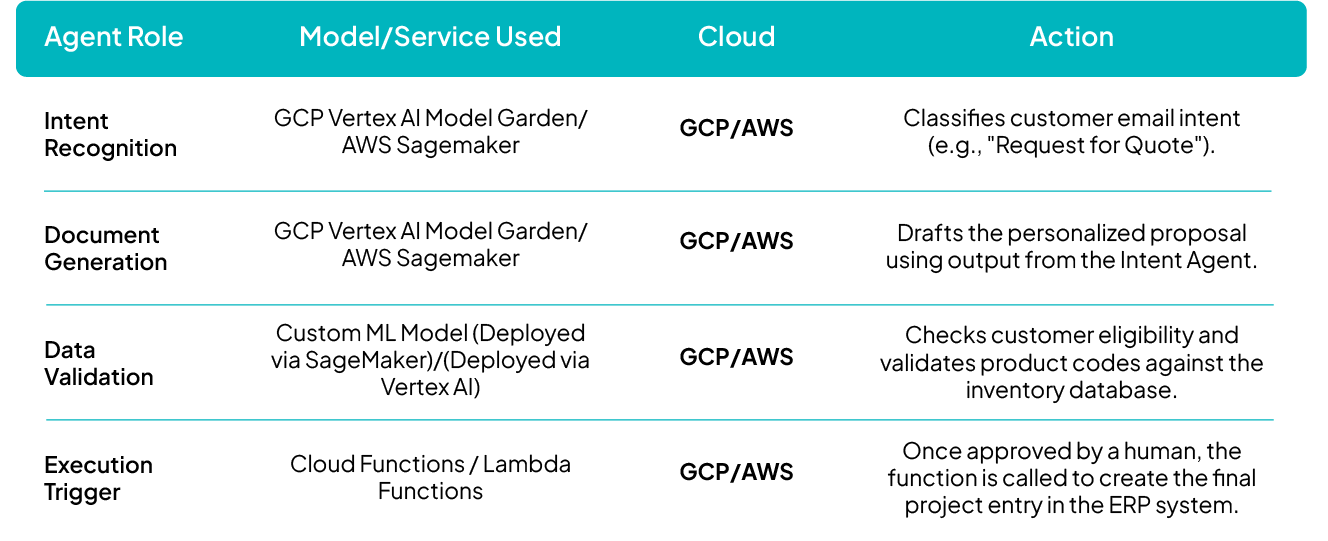
Real-World Use Case: Enquiry-to-Execution Workflow
To illustrate the multi-cloud collaboration, consider the Enquiry-to-Execution Workflow where speed and data accuracy are critical:
How Ankercloud Accelerates Your Agentic Deployment
Deploying resilient, multi-cloud Agentic AI is highly complex, requiring expertise across multiple hyperscalers and MLOps practices.
- Multi-Cloud Expertise: As a Premier Partner for AWS and GCP, we architect unified data governance and security models that ensure seamless, compliant agent operation regardless of which cloud service is hosting the model or data.
- Accelerated Deployment: We utilize pre-built, production-ready MLOps templates and orchestration frameworks specifically designed for multi-agent systems, drastically cutting time-to-market.
- Cost Optimization: We design the architecture to strategically leverage the most cost-efficient compute (e.g., specialized GPUs) or managed services available on either AWS or GCP for each task.
Ready to transition your proof-of-concept into a production-ready autonomous workflow?
Partner with Ankercloud to secure and scale your multi-cloud Agentic AI architecture.
Agentic AI Use Cases: Transforming Core Business Workflows for RealWorld ROI
The Shift: From Experimentation to Execution
Ready to ditch the manual bottlenecks and elevate your business with intelligent automation?
The next wave of AI isn't about isolated tasks, it's about orchestrating entire workflows. Dive into our latest use cases to see how Agentic AI is driving 90% reduction in manual data entry, cutting quote to execution time by 70%, and transforming product creation with Vision + GenAI Fusion. This is how you achieve real world ROI, not just potential.
The breakthrough lies in moving beyond simple chatbots and static machine learning models to deploy autonomous systems that solve complex, multi step business problems end to end. At Ankercloud, we are engineering these MultiAgent Workflows to drive profound efficiencies across the enterprise.
1. Intelligent Order Entry & Fulfilment Automation
Enterprises frequently lose time and accuracy translating customer purchase orders (POs) across various channels (email, PDF, voice) into their core ERP systems. Agentic AI automates this entire order lifecycle, from customer inquiry to final dispatch.
Solution: A MultiAgent Order Orchestration System
.png)
Outcome
90% reduction in manual data entry
End to end order processing automation
Integration ready with systems like SAP, Salesforce, and custom CRMs.
2. EnquirytoExecution Workflow (E2E Intelligent Process Automation)
The time lost between receiving a customer inquiry and beginning the final deliverable (e.g., quote -> approval -> project start) creates unnecessary human bottlenecks. Agentic AI now automates this "middle office" process.
Solution: A MultiAgent Process Automation System
%20%20(1).png)
Outcome
Cuts enquiry to execution time by up to 70%.
No human bottlenecks in approvals.
Ensures consistent quote and contract templates via GenAI.
3. Image Generation & 3D Model Conversion (Vision + GenAI Fusion)
Industries like jewelry, textiles, e-commerce, and architecture require fast, high quality asset creation (e.g., product photography -> 3D render -> virtual showroom). Agentic AI fuses Vision and Generative models to automate this content pipeline.
Solution: An AI Imageto3D Conversion Suite
%20%20(1).png)
Outcome
10$\times$ faster product modeling.
80% cost reduction in 3D asset creation.
Assets are metaverse / AR commerce ready.
4. Autonomous Quotation & Pricing Engine
Sales teams need dynamic quoting that reacts instantly to live market inputs (demand, margin, competition) but often get slowed down by manual approval loops. Agentic AI generates, optimizes, and approves quotes autonomously.
Solution: A MultiAgent Quoting System
.png)
Outcome
Enables real time dynamic pricing.
Accelerates sales closure and improves margin accuracy.
Reduced approval loops and human bottlenecks.
The Future of Work is Autonomous
These use cases demonstrate that Agentic AI is not just about isolated tasks; it’s about holistic workflow automation. By deploying multi agent systems, Ankercloud helps enterprises eliminate manual friction, reduce operational costs, and unlock unprecedented speed.
Ready to identify your first high ROI Agentic AI use case?
Partner with Ankercloud to transform your core business processes.
ALBeast Vulnerability: What It Is and How to Protect Your Applications
A newly identified vulnerability called "ALBeast" can cause a significant risk for AWS Application Load Balancer (ALB) using the load balancer authentication. This vulnerability was found by Miggo Research, meaning it is a severe problem that can lead to unauthorized access, data exfiltration, data breaches, and insider threats. Understanding it and mitigating this vulnerability is essential to organizations that are relying on the AWS Application Load Balancer to secure their applications.
Understanding ALBeast: What You Need to Know
ALBeast is a configuration-based vulnerability, the base of this vulnerability is "how AWS ALB handles the user authentication". ALB is a load balancer that operates on the OSI model's Layer 7. Its purpose is to handle the traffic by distributing the incoming application traffic across multiple targets like EC2 instances, containers, or IP addresses. On the one hand, the ALB improves reliability, fault tolerance, and scalability. And, the misconfiguration in ALB's authentication process can lead to a security breach where applications are exposed to the risk of being compromised.
The ALBeast vulnerability is critical because, with the help of this vulnerability, the attackers can bypass the critical security controls and lead to unauthorized access, by which attackers can access the applications without authentication. The Miggo research has identified over 15,000 potentially vulnerable applications out of the 371,000 ALBs analyzed, these potentially vulnerable applications do not contain the proper signer validation which is a key contributor to ALB-based authentication.
How Does ALBeast Vulnerability Work?
The ALBeast vulnerability exploits the weaknesses in how the applications validate the tokens provided by ALB. This vulnerability is raised because of two main issues which are:
- Missing Signer Validation: Many of the applications fail to verify the authenticity of the token signer, which means that the attacker can forge a token, manipulate it, impersonate it as a legitimate token, and present it to the application. Because of this misconfiguration, the application does not validate the signer's identity, accepts the token then grants the attacker unauthorized access.
- Misconfigured Security Groups: ALBeast vulnerability also takes advantage of misconfigurations in configured security groups that do not restrict traffic to trusted ALB instances. If an application accepts traffic from any source rather than limiting it to a specific ALB, an attacker can exploit this to bypass security controls.
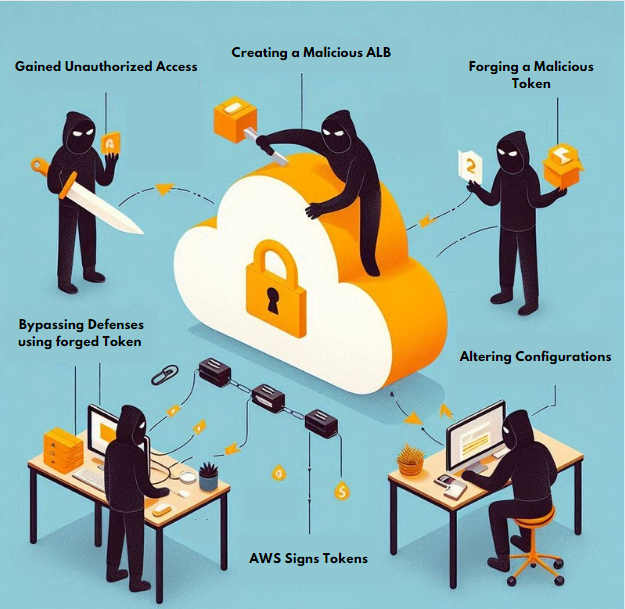
Exploitation Scenario: How Attackers Exploit
- Setting Up a Malicious ALB: The attacker creates the malicious Application Load Balancer (ALB) which has similar configurations to the victim's setup.
- Forging a Token: The attacker forges a token and changes the information inside it, especially the part that says who issued it, to match what the victim’s application considers legitimate.
- Altering the Configurations: The attacker changes the configurations on the Malicious ALB so that AWS signs the token in a way that makes it look legitimate to the victim’s system.
- Bypassing Defenses: The attacker then uses this fake token to trick the victim’s application into bypassing security checks and gaining unauthorized access.
Best Practices to Mitigate ALBeast
- Verify Token Signer: Ensure that the applications are validating the signer of a JWT token provided with ALB to verify that the signer field from the JWT header matches the Amazon Resource Name (ARN) of the ALB signing the token.
- Restrict Traffic to Trusted ALBs: Configure your security groups to accept traffic only from trusted ALB instances. This can be achieved by referencing the ALB’s security group in the inbound rules for your target security group.
- Deploy Targets in Private Subnets: To prevent direct access from the public internet, deploy your ALB targets in private subnets without public IP addresses or Elastic IP addresses.
- Review and Update Configurations: Regularly review your application’s configurations to ensure they adhere to the latest AWS documentation. AWS has updated its authentication feature documentation to include new code for validating the signer, making it crucial for users to implement these changes.
Conclusion
The ALBeast vulnerability is a wake-up call for all organizations about how misconfigurations can lead to complex vulnerabilities in cloud-based applications. AWS has provided reliable tools for security management, though the responsibility to properly set up these tools is on the user. Organizations can immensely reduce the threat of unauthorized access to their applications based on the ALBeast issue by following the recommended mitigation strategies. These security risks accompany the continuous changes in cloud environments. The organizations should keep themselves up to date, ensure that they regularly update the configurations, and prepare to defend against threats like ALBeast.