00 min read
The "Dashboard Fatigue" in Modern IoT
Modern IoT environments are incredibly talkative. Every second, they generate a mountain of telemetry, alarms, and metadata. Platforms like ThingsBoard have done a brilliant job of collecting and visualizing this data, but there is a hidden cost: Access.
Historically, if you wanted to extract a specific contextual insight—like analyzing a temperature anomaly over a 7-day period, you needed one of three things: deep platform familiarity, REST API scripting skills, or a custom-built dashboard. This creates an "operational gate" where only technical users can truly "speak" to the machines.
At Ankercloud, we believe the next evolution of Industry 4.0 isn't just about more data, it’s about Conversational Intelligence.
Introducing the ThingsBoard MCP Server
The game-changer in this space is the Model Context Protocol (MCP). By implementing a dedicated ThingsBoard MCP Server, we are layering a secure intelligence interface over your existing deployment.
This allows Large Language Models (LLMs) and AI agents (like Claude or Gemini) to interact directly with your ThingsBoard environment. You no longer need to navigate three different nested dashboards to find a fault; you simply ask the AI to find it for you.
Architecture Overview: The Intelligence Layer
The ThingsBoard MCP Server acts as the secure translator between human intent and machine data. Instead of manual API calls, the system follows a seamless, automated flow:
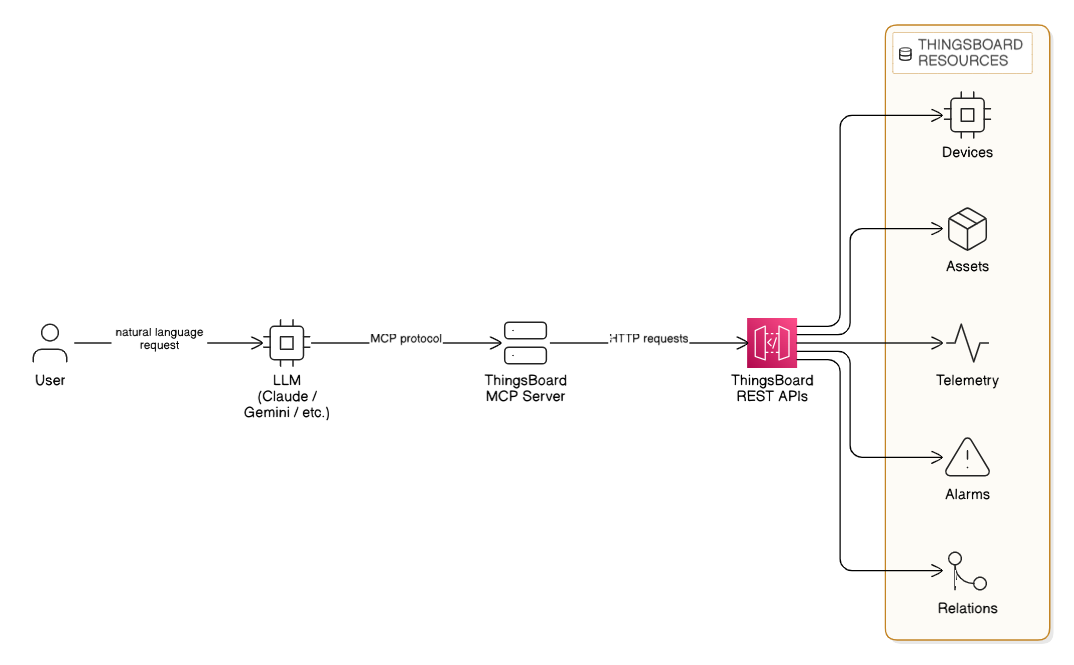
- User Request: A user makes a request in plain English (e.g., "Analyze Site-A telemetry").
- LLM Processing: An LLM (Claude, Gemini, etc.) interprets the intent.
- MCP Protocol: The LLM communicates with the ThingsBoard MCP Server via the MCP protocol.
- API Execution: The MCP server sends structured HTTP requests to the ThingsBoard REST APIs.
- Resource Retrieval: The system securely accesses specific ThingsBoard Resources including Devices, Assets, Telemetry, Alarms, and Entity Relations.
This architecture ensures that your data remains secure within your environment while becoming instantly accessible through conversation.
From "Scripting" to "Asking": A Paradigm Shift
Traditional IoT operations rely on manual exploration. The ThingsBoard MCP Server replaces that friction with natural language.
Imagine your operations team asking:
- "Analyze the vibration anomalies for Machine-12 over the last 48 hours."
- "Which Site-A sensors triggered critical alarms yesterday?"
- "Show me the relationship between this failed pump and its upstream power supply."
The MCP server translates these human requests into structured API calls, analyzes the results, and hands you back an actionable answer in seconds.
Four Core Capabilities of AI-Driven Operations
1. Intelligent Entity Management
AI agents can now navigate your assets, devices, and hierarchies through conversation. This makes administrative tasks like checking credentials or mapping new customers, faster and more intuitive for non-technical stakeholders.
2. Contextual Telemetry Interaction
Retrieving time-series data usually requires setting up specific widgets. With MCP, your AI agent can fetch aggregated data, compare latest values, and even update telemetry keys through a single chat interface. It turns "data points" into "data stories."
3. Rapid Alarm Intelligence
Root-cause analysis is often a race against the clock. AI agents can instantly filter alarms by severity, identify high-risk alert clusters, and cross-reference them with historical trends to tell you not just what happened, but why it might be happening again.
4. Navigating the Digital Twin
The true power of ThingsBoard lies in its entity relationships. The MCP server allows AI systems to traverse asset hierarchies and discover directional relations. This adds true contextual intelligence, understanding that a "High Heat" alarm on a motor is critical because that motor powers a "Priority-1" production line.
Why This Matters: The Business Impact
As an AWS and GCP Premier Tier Partner, Ankercloud sees a recurring theme among our global industrial clients: They want to move faster.
Introducing MCP-driven AI operations delivers measurable ROI by:
- Reducing Dashboard Dependency: Empowering managers to get insights without waiting for a technical report.
- Accelerating Root-Cause Analysis: Turning hours of manual data-combing into seconds of AI-assisted investigation.
- Improving Platform Adoption: Making advanced IoT data accessible to everyone in the organization, from the shop floor to the C-suite.
The Future is Autonomous
ThingsBoard has evolved from a monitoring platform into an Intelligent Operational Assistant. With the ThingsBoard MCP Server, your IoT platform is no longer just a collection of charts, it’s a conversational partner that understands your business rules and your machine data.
AI-driven IoT operations are no longer a future concept; they are a production-ready reality that simplifies the complex.
Ready to turn your IoT data into conversational intelligence? Contact Ankercloud today for a 1-hour strategy session on ThingsBoard MCP integration.
Conversational IoT: How MCP-Driven AI is Redefining ThingsBoard Operations
The "Dashboard Fatigue" in Modern IoT
Modern IoT environments are incredibly talkative. Every second, they generate a mountain of telemetry, alarms, and metadata. Platforms like ThingsBoard have done a brilliant job of collecting and visualizing this data, but there is a hidden cost: Access.
Historically, if you wanted to extract a specific contextual insight—like analyzing a temperature anomaly over a 7-day period, you needed one of three things: deep platform familiarity, REST API scripting skills, or a custom-built dashboard. This creates an "operational gate" where only technical users can truly "speak" to the machines.
At Ankercloud, we believe the next evolution of Industry 4.0 isn't just about more data, it’s about Conversational Intelligence.
Introducing the ThingsBoard MCP Server
The game-changer in this space is the Model Context Protocol (MCP). By implementing a dedicated ThingsBoard MCP Server, we are layering a secure intelligence interface over your existing deployment.
This allows Large Language Models (LLMs) and AI agents (like Claude or Gemini) to interact directly with your ThingsBoard environment. You no longer need to navigate three different nested dashboards to find a fault; you simply ask the AI to find it for you.
Architecture Overview: The Intelligence Layer
The ThingsBoard MCP Server acts as the secure translator between human intent and machine data. Instead of manual API calls, the system follows a seamless, automated flow:
- User Request: A user makes a request in plain English (e.g., "Analyze Site-A telemetry").
- LLM Processing: An LLM (Claude, Gemini, etc.) interprets the intent.
- MCP Protocol: The LLM communicates with the ThingsBoard MCP Server via the MCP protocol.
- API Execution: The MCP server sends structured HTTP requests to the ThingsBoard REST APIs.
- Resource Retrieval: The system securely accesses specific ThingsBoard Resources including Devices, Assets, Telemetry, Alarms, and Entity Relations.
This architecture ensures that your data remains secure within your environment while becoming instantly accessible through conversation.
From "Scripting" to "Asking": A Paradigm Shift
Traditional IoT operations rely on manual exploration. The ThingsBoard MCP Server replaces that friction with natural language.
Imagine your operations team asking:
- "Analyze the vibration anomalies for Machine-12 over the last 48 hours."
- "Which Site-A sensors triggered critical alarms yesterday?"
- "Show me the relationship between this failed pump and its upstream power supply."
The MCP server translates these human requests into structured API calls, analyzes the results, and hands you back an actionable answer in seconds.
Four Core Capabilities of AI-Driven Operations
1. Intelligent Entity Management
AI agents can now navigate your assets, devices, and hierarchies through conversation. This makes administrative tasks like checking credentials or mapping new customers, faster and more intuitive for non-technical stakeholders.
2. Contextual Telemetry Interaction
Retrieving time-series data usually requires setting up specific widgets. With MCP, your AI agent can fetch aggregated data, compare latest values, and even update telemetry keys through a single chat interface. It turns "data points" into "data stories."
3. Rapid Alarm Intelligence
Root-cause analysis is often a race against the clock. AI agents can instantly filter alarms by severity, identify high-risk alert clusters, and cross-reference them with historical trends to tell you not just what happened, but why it might be happening again.
4. Navigating the Digital Twin
The true power of ThingsBoard lies in its entity relationships. The MCP server allows AI systems to traverse asset hierarchies and discover directional relations. This adds true contextual intelligence, understanding that a "High Heat" alarm on a motor is critical because that motor powers a "Priority-1" production line.
Why This Matters: The Business Impact
As an AWS and GCP Premier Tier Partner, Ankercloud sees a recurring theme among our global industrial clients: They want to move faster.
Introducing MCP-driven AI operations delivers measurable ROI by:
- Reducing Dashboard Dependency: Empowering managers to get insights without waiting for a technical report.
- Accelerating Root-Cause Analysis: Turning hours of manual data-combing into seconds of AI-assisted investigation.
- Improving Platform Adoption: Making advanced IoT data accessible to everyone in the organization, from the shop floor to the C-suite.
The Future is Autonomous
ThingsBoard has evolved from a monitoring platform into an Intelligent Operational Assistant. With the ThingsBoard MCP Server, your IoT platform is no longer just a collection of charts, it’s a conversational partner that understands your business rules and your machine data.
AI-driven IoT operations are no longer a future concept; they are a production-ready reality that simplifies the complex.
Ready to turn your IoT data into conversational intelligence? Contact Ankercloud today for a 1-hour strategy session on ThingsBoard MCP integration.
Related Blogs
Beyond the Factory Floor: Why Your Smart Manufacturing Strategy Needs IoT and CRM Integration
The Intelligence Gap in Industry 4.0
For the past decade, the "Smart Factory" has been the holy grail of manufacturing. We have invested billions into automation, edge computing, and real-time monitoring. Our machines are talkative streaming runtime data, fault codes, and OEE metrics 24/7.
But here is the hard truth: If your factory floor doesn’t talk to your customer service team, your factory isn’t truly "smart."
A critical gap still exists in most industrial organizations. Operational data (OT) rarely connects directly to Customer Relationship Management (CRM) systems. This disconnect creates a "visibility wall" where the people responsible for the machines know exactly what’s happening, but the people responsible for the customers are left in the dark.
At Ankercloud, we believe the future of manufacturing isn't just defined by automation, it’s defined by connectivity and customer-centricity.
The High Cost of Siloed Systems
When factory operations and customer engagement live in separate silos, the business pays the price in friction:
- Service teams are reactive: They wait for a customer to call and complain about a breakdown that the machine reported hours ago.
- SLA risks are invisible: Production slowdowns go unnoticed by sales teams until a delivery is already late.
- Trust is eroded: Customers receive delayed information, leading to frustration and missed opportunities for proactive support.
A smart factory without a connected CRM is like a high-performance engine without a dashboard, it’s running fast, but you have no idea if you’re heading toward a breakdown or a finish line.
Closing the Loop: The IoT + CRM Architecture
Integrating an Industry 4.0 IoT platform with your CRM (like Salesforce, Dynamics 365, or HubSpot) creates a live reflection of your operations. Here is how we build that bridge:
- The Factory Layer: Sensors and PLCs collect machine telemetry (vibration, heat, cycles) in real-time via OPC-UA or MQTT gateways.
- The IoT Platform Layer: A platform like AWS IoT Core ingests this data, computes KPIs like OEE, and triggers alarms based on anomalies.
- The CRM Integration Layer: This is where the magic happens. Through secure APIs, factory events trigger automated workflows in your CRM.
Four Use Cases That Redefine the Customer Experience
How does this integration look in practice?
1. The "Self-Healing" Service Case
A machine on the floor throws a fault code. Instead of waiting for a manual check, the IoT platform automatically creates a service case in the CRM, assigns a technician, and orders the necessary replacement part before the production manager even finishes their coffee.
2. Proactive SLA Guardrails
If production throughput falls below a certain threshold on a custom order, the system detects a potential delay. The CRM instantly updates the account manager, allowing them to notify the customer proactively with a new timeline, preserving trust through transparency.
3. Predictive Maintenance as a Service
Using AI-driven analytics, we identify degradation trends. The CRM then automatically schedules preventive maintenance during a planned customer downtime window, ensuring the machine never reaches the point of actual failure.
4. Direct Customer Portals
Imagine a world where your customers don’t have to call for an update. They can log into a portal powered by your CRM and see the near real-time production status of their specific order, driven by live IoT data from the line.
The Business Impact: Turning Data into Revenue
Integrating IoT with CRM isn't just a technical upgrade; it's a financial one. Our clients see measurable ROI in:
- 80% faster issue response times: Moving from manual reporting to automated triggers.
- Higher Customer Lifetime Value (CLV): Transparency and proactivity build long-term loyalty.
- Optimized Service Revenue: Predictive maintenance allows you to sell "uptime" as a service rather than just parts and labor.
The Ankercloud Edge
As an AWS and GCP Premier Tier Partner, Ankercloud specializes in building the "connective tissue" of modern manufacturing. We don't just deploy sensors; we engineer end-to-end ecosystems where machine telemetry becomes a revenue-enabling asset.
Industry 4.0 is no longer just about making things better; it’s about serving people better. By making your factory "customer-aware," you aren't just building a smart factory, you’re building a connected, intelligent, and future-proof business.
Is your factory talking to your customers? Contact Ankercloud today for a 1-hour strategy session on IoT and CRM integration.
Agentic AI Architecture: Building Autonomous, Multi-Cloud Workflows on AWS & GCP
The Technical Shift: From Monolithic Models to Autonomous Orchestration
Traditional Machine Learning (ML) focuses on predictive accuracy; Agentic AI focuses on autonomous action and complex problem-solving. Technically, this shift means moving away from a single model serving one function to orchestrating a team of specialized agents, each communicating and acting upon real-time data.
Building this requires a robust, cloud-native architecture capable of handling vast data flows, secure communication, and flexible compute resources across platforms like AWS and Google Cloud Platform (GCP).
Architectural Diagram Description
.png)
.png)
Visual Layout: A central layer labeled "Orchestration Core" connecting to left and right columns representing AWS and GCP services, and interacting with a bottom layer representing Enterprise Data.
1. Enterprise Data & Triggers (Bottom Layer):
- Data Sources: External APIs, Enterprise ERP (SAP/Salesforce), Data Lake (e.g., AWS S3 and GCP Cloud Storage).
- Triggers: User Input (via UI/Chat), AWS Lambda (Event Triggers), GCP Cloud Functions (Event Triggers).
2. The Orchestration Core (Center):
- Function: This layer manages the overall workflow, decision-making, and communication between specialized agents.
- Tools: AWS Step Functions / GCP Cloud Workflows (for sequential task management) and specialized Agent Supervisors (LLMs/Controllers) managing the Model Context Protocol.
3. Specialized Agents & Models (AWS Side - Left):
- Foundation Models (FM): Amazon Bedrock (access to Claude, Llama 3, Titan)
- Model Hosting: Amazon SageMaker Endpoints (Custom ML Models, Vision Agents)
- Tools: AWS Kendra (RAG/Knowledge Retrieval), AWS Lambda (Tool/Function Calling)
4. Specialized Agents & Models (GCP Side - Right):
- Foundation Models (FM): Google Vertex AI Model Garden (access to Gemini, Imagen)
- Model Hosting: GCP Vertex AI Endpoints (Custom ML Models, NLP Agents)
- Tools: GCP Cloud SQL / BigQuery (Data Integration), GCP Cloud Functions (Tool/Function Calling)
Key Technical Components and Function
1. The Autonomous Agent Core
Agentic AI relies on multi-agent systems, where specialized agents collaborate to solve complex problems:
- Foundation Models (FM): Leveraging managed services like AWS Bedrock and GCP Vertex AI Model Garden provides scalable, secure access to state-of-the-art LLMs (like Gemini) and GenAI models without the burden of full infrastructure management.
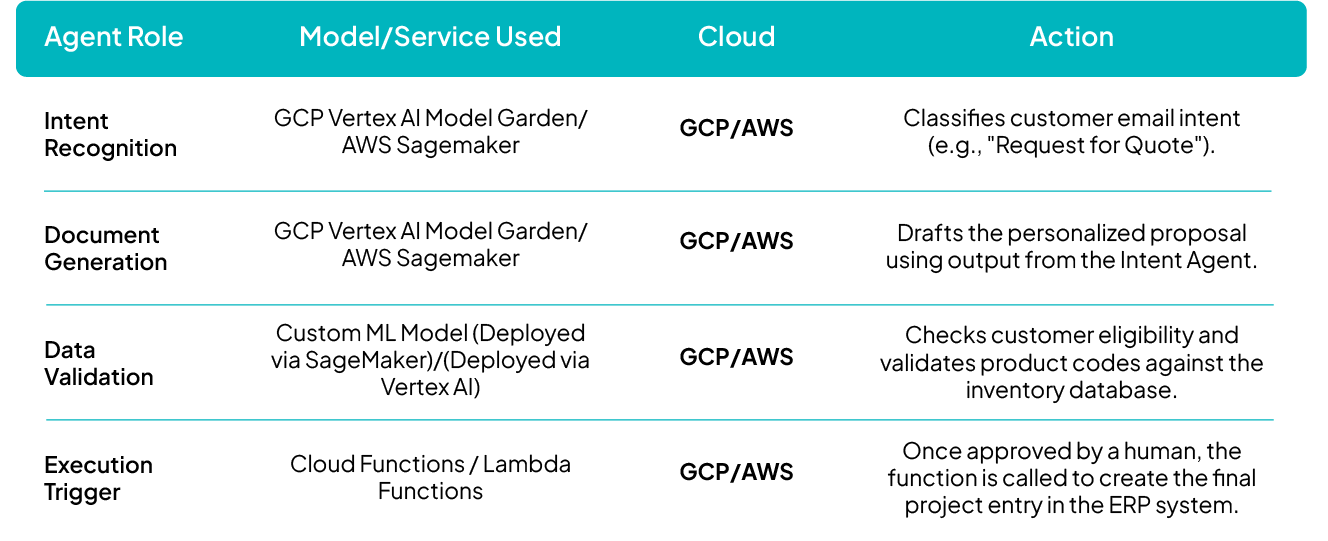
- Tool Calling / Function Invocation: Agents gain the ability to act by integrating with external APIs and enterprise systems. This is handled by Cloud Functions or Lambda Functions (e.g., AWS Lambda or GCP Cloud Functions) that translate the agent's decision into code execution (e.g., checking inventory in SAP).
- RAG (Retrieval-Augmented Generation): Critical for grounding agents in specific enterprise data, ensuring accuracy and avoiding hallucinations. Services like AWS Kendra or specialized embeddings stored in Vector Databases (like GCP Vertex AI Vector Search) power precise knowledge retrieval.
2. Multi-Cloud Orchestration for Resilience
Multi-cloud deployment provides resilience, avoids vendor lock-in, and optimizes compute costs (e.g., using specialized hardware available only on one provider).
- Workflow Management: Tools like AWS Step Functions or GCP Cloud Workflows are used to define the sequential logic of the multi-agent system (e.g., Task Agent $\rightarrow$ Validation Agent $\rightarrow$ Execution Agent).
- Data Consistency: Secure, consistent access to enterprise data is maintained via secure private links and unified data lakes leveraging both AWS S3 and GCP Cloud Storage.
- MLOps Pipeline: Continuous Integration/Continuous Delivery (CI/CD) pipelines ensure agents and their underlying models are constantly monitored, re-trained, and deployed automatically across both cloud environments.
Real-World Use Case: Enquiry-to-Execution Workflow
To illustrate the multi-cloud collaboration, consider the Enquiry-to-Execution Workflow where speed and data accuracy are critical:
How Ankercloud Accelerates Your Agentic Deployment
Deploying resilient, multi-cloud Agentic AI is highly complex, requiring expertise across multiple hyperscalers and MLOps practices.
- Multi-Cloud Expertise: As a Premier Partner for AWS and GCP, we architect unified data governance and security models that ensure seamless, compliant agent operation regardless of which cloud service is hosting the model or data.
- Accelerated Deployment: We utilize pre-built, production-ready MLOps templates and orchestration frameworks specifically designed for multi-agent systems, drastically cutting time-to-market.
- Cost Optimization: We design the architecture to strategically leverage the most cost-efficient compute (e.g., specialized GPUs) or managed services available on either AWS or GCP for each task.
Ready to transition your proof-of-concept into a production-ready autonomous workflow?
Partner with Ankercloud to secure and scale your multi-cloud Agentic AI architecture.
Beyond Dashboards: The Four Dimensions of Data Analysis for Manufacturing & Multi-Industries
The Intelligence Gap: Why Raw Data Isn't Enough
Every modern business - whether on a shop floor or in a financial trading room is drowning in data: sensor logs, transactions, sales records, and ERP entries. But how often does that raw data actually tell you what to do next?
Data Analysis bridges this gap. It's the essential process of converting raw operational, machine, supply chain, and enterprise data into tangible, actionable insights for improved productivity, quality, and decision-making. We use a combination of historical records and real-time streaming data from sources like IoT sensors, production logs, and sales systems to tell a complete story.
To truly understand that story, we rely on four core techniques that move us from simply documenting the past to confidently dictating the future.
The Four Core Techniques: Moving from 'What' to 'Do This'
Think of data analysis as a journey with increasing levels of intelligence:
- Descriptive Analytics (What Happened): This is your foundation. It answers: What are my current KPIs? We build dashboards showing OEE (Overall Equipment Effectiveness), defect percentage, and downtime trends. It’s the essential reporting layer.
- Diagnostic Analytics (Why It Happened): This is the root cause analysis (RCA). It answers: Why did that machine fail last week? We drill down into correlations, logs, and sensor data to find the precise factors that drove the outcome.
- Predictive Analytics (What Will Happen): This is where AI truly shines. It answers: Will this asset break in the next month? We use sophisticated time series models (like ARIMA or Prophet) to generate highly accurate failure predictions, demand forecasts, and churn probabilities.
- Prescriptive Analytics (What Should Be Done): This is the highest value. It answers: What is the optimal schedule to prevent that failure and meet demand? This combines predictive models with optimization engines (OR models) to recommend the exact action needed—such as optimal scheduling or smart pricing strategy.
Multi-Industry Use Cases: Solving Real Business Problems
The principles of advanced analytics apply everywhere, from the shop floor to the trading floor. We use the same architectural patterns—the Modern Data Stack and a Medallion Architecture—to transform different kinds of data into competitive advantage.
In Manufacturing
- Predictive Maintenance: Using ML models to analyze vibration, temperature, and load data from IoT sensors to predict machine breakdowns before they occur.
- Quality Analytics: Fusing Computer Vision systems with core analytics to detect defects, reduce scrap, and maintain consistent product quality.
- Supply Chain Optimization: Analyzing vendor risk scoring and lead time data to ensure stock-out prevention and precise production planning.
In Other Industries
- Fraud Detection (BFSI): Deploying anomaly and classification models that flag suspicious transactions in real-time, securing assets and reducing financial risk.
- Route Optimization (Logistics): Using GPS and route history data with optimization engines to recommend the most efficient routes and ETAs.
- Customer 360 (Retail/Telecom): Using clustering and churn models to segment customers, personalize retention strategies, and accurately forecast demand.
Ankercloud: Your Partner in Data Value
Moving from basic descriptive dashboards to autonomous prescriptive action requires expertise in cloud architecture, data science, and MLOps.
As an AWS and GCP Premier Partner, Ankercloud designs and deploys your end-to-end data platform on the world's leading cloud infrastructure. We ensure:
- Accuracy: We build robust Data Quality and Validation pipelines to ensure data freshness and consistency.
- Governance: We establish strict Cataloging & Metadata frameworks (using tools like Glue/Lake Formation) to provide controlled, logical access.
- Value: We focus on delivering tangible Prescriptive Analytics that result in better forecast accuracy, faster root cause fixing, and verifiable ROI.
Ready to stop asking "What happened?" and start knowing "What should we do?"
Partner with Ankercloud to unlock the full value of your enterprise data.